Hi everyone
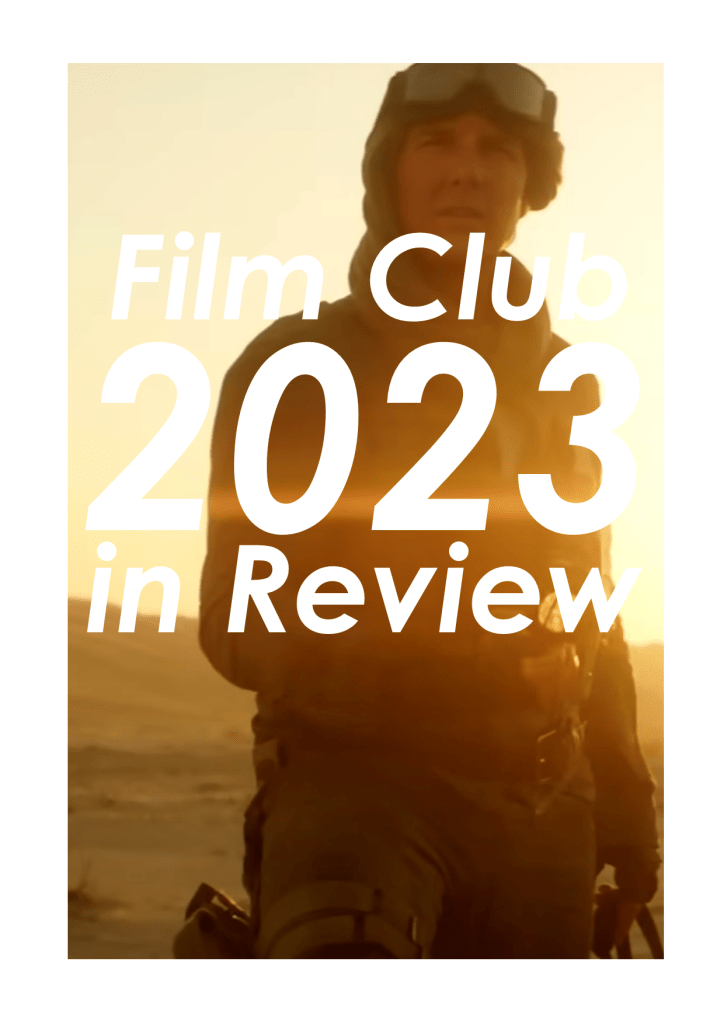
Yep. Welcome to the London Graphic Novel Network Film Club’s 2023 in Review.
(And the crowd goes wild).
Oh. Thank you.
For those of you who haven’t played before – Here are the rules:
1. Yes. You can talk about any film you like
It doesn’t need to have come out this year. It doesn’t even have to be something that you liked. If there was a film that you really hated then you can talk about that. Or maybe you felt massively lukewarm about it. The only real requirement is that it’s something that you’ve seen in this past year and there’s something you want to say about it. (You’re also welcome to lobby for any particular film that you feel like the LGNN Film Club should do in the future if you feel like it…).
2. Name the film in bold at the start of what you write
That way if someone wants to see it and they don’t wanna get spoiled then they can just skip over it with no harm done. (Also if you can find some images from the film and include them – then that would be cool too).
3. Please don’t just recount the plot instead: tell us what you think
Instead of just writing a synopsis (yawn) try this – Talk about what you liked (or didn’t like) about it. But grabbed you / what left you cold. What it did well / what it could have done better. How it made you feel. What kind of things it made you think about. All that good stuff.
4. If someone else has already mentioned a film then don’t worry – that’s ok
This isn’t a first come / first served thing. If someone else has mentioned a film then it’s not off the table – you can still write about it all you want. Ideally we don’t just want lots of solipsistic thoughts floating separately from each other so yeah – if someone mentions a film and you have a differing view please feel free to share (just you know obviously – try to play nice).
5. If you want to talk about a film that the LGNN Film Club has already done then that’s cool too
I’ve often been told that three weeks is never long enough. So if we talked about a particular film at some point in the past and you felt like there was stuff you wanted to say about it that you didn’t get a chance to say – then now’s the time… Go crazy.
If you’re still a little unsure how it works please feel free to look at how we’ve done it in the past:
So. I think that’s it. Hopefully should be fun and interesting and a cool time for everyone (that’s the idea anyway).
Have fun out there.

Wonka (2023)
Tim Burton’s Alice in Wonderland had the potential to have been good – a property primed to let a creative genius go completely mad, but much as it’s easier to imagine the end of the world than the end of capitalism, so it’s easier to go to Harry Potter asset library to patch together a by-the-numbers CGI fuckfest, although much harder to remember several years later. Similarly Inception, where having set the plate for physics bending dreams within dreams it turned out all the actual dreams are pretty hard to distinguish from reality. In both cases there was room to push the limits well established film rules and instead in many ways there fulfilled standard action tropes. To be fair Alice in Wonderland made a lot of cash, but what we actually got was Disney’s Alice in Wonderland with a bit of Tim Burton thrown in. Also disappointing because Tim Burton’s previous adaptation – Charlie and the Chocolate factory, while faithful was brave enough to break the character of Wonka in to a sort of weird Michael Jackson figure, introduce some more backstory elements, and add a bit of character here and there.
It’s a dangerous challenge, because I wonder if there is anyone under fifty in the anglophone world who hasn’t read Charlie and the Chocolate Factory, but there in lies the opportunity for a prequel free from the restrictions of exposition. As it happens the book contains a number of accounts of the history of Willy Wonka, and how he became a mysterious recluse. So this prequel could have easily just been a retelling of those stories with some padding and as I sat down, I said to myself “aah the travels of Willy Wonka: He’ll go to Loompaland of course, and he’ll make the castle out of chocolate for the guy, and presumably there’ll be some sort of foreshadowing of the book and Wonka will basically be a chocolate Tony Stark.” But no, and why by no means did the film push the boundaries of imagination, it does at least mess with the mold… by using a different template.
For this is not Tim Burton’s Wonka, nor is this Disney or Marvel, Warner Bros’ Wonka. This is Paddington Wonka, and much like Paddington, the journey of the main character is not for the protagonist to change, but for the world to change around them, as all attempts to dent their belief in the strength of good deeds and good intentions are dashed in the face of irrepressible positivity.
Wonka is not ground down by trials and travails into the sort of man who fires is workforce and exposes children to dangerous experiments. Rather he is Chocolate Jesus, or since it’s played by Timothee Chalomet Choclate Kwisatz Hadderach. The film even does an inverse of the hero journey where instead of reaching rock bottom Wonka has everything he wants halfway through, but it’s the lack of satisfaction of success which brings him low, rather than losing everything. For 95% of the runtime Timothee Chalomet is super happy and optimistic, and rather than being saccharine, like Paddington the film is better for it.
Again this is an interesting creative decision because we *know* that Wonka becomes an embittered and brittle recluse, but throughout this movie he displays uncanny resilience. So contrary to a prequel which aims to fill in the backstory of well loved characters, instead it is almost and alternate reality where the character doubles down on who they ought to be at every turn, liberating friends and enemies alike through the power of chocolate.
However it does pose the question about whether it needed to be Wonka at all. Is there any reason besides marketing why this couldn’t have been “Chocolate Aslan” and been exactly the same movie? Maybe only the Oompa Lumpahs, hardly a particularly plot specific issue, are something which *needs* to be linked to the original book. It doesn’t even use the Oompa Lumpah backstory provided by Ronald Dahl, and quite rightly. If 2023 has shown us anything is that you can make your movie 20% better just by having Hugh Grant quipping in the background every so often, as demonstrated by actual movie of the year Dungeons & Dragons: Honour Among Thieves.
If it comes down to a question about these creative decisions to jettison large sections of the original themes of the book are bad or good, I think the answer has to be that the writers did what was necessary to make something consistent. By contrast we can look to the Cruella movie as a sort of experiment control to demonstrate how easy it is to get tied in knots trying to set up a beloved children’s classic while telling a new story. Maybe Ronald Dhal is spinning in his grave but I am not sure so many people are dialled into Wonka lore that they will feel this is a betrayal of the expanded universe. At the very least it made me give a thoughtful “huh.”

The Hunt
Directed by Craig Zobel

What do you want from a movie?
It seems like nowadays most people want to see movies that are going to affirm their politics and their point of view on the world. “Yes. That’s right. You’re right. And everyone else is wrong. You understand things that other people don’t. You’re paying attention to the right perspectives. You’re morally good and everyone else is an unfeeling monster that doesn’t know how to do empathy.” etc etc etc
Most of the time that’s not something I have that much truck with. I mean yeah Flowers of the Killer Moon is a very good immaculately made movie and all but watching it feels like taking a big fat misery bath for three hours. I mean by the end I feel a crushing weight of despair but I’m not sure what the point is? I mean – I know the forces of evil have won and are slowly killing everything that’s pure and right in the pursuit of almighty capital. I’m just not sure how it helps things to get sad about it too?
Or you know – something something raising awareness something something.
I mean when I watch a movie all I really want is some sort of entertainment. Something that’s going to make me smile and cheer and shout out “holy fuck!” every half an hour or so.
Well – ladies and gentlemen: The Hunt is very much that movie.

If you’re heard about this movie at all then I’m guessing you know it more by reputation rather than what the film is actually about. Around about the time it came out it kinda got sucked into a little bit of a culture war because everyone thought it was about a bunch of liberal do-gooder democrats rounding up a bunch of deplorable republicans and hunting them for sport. Which erm yeah is kinda definitely what the movie is about but it’s also a lot more self-aware than that. I mean – I was planning to go and see it until the pandemic hit and then it kinda slipped off my radar until a few weeks ago I saw a clip on Twitter of one character saying “Cigarettes in Arkansas only cost six bucks. You fucked up, bitch!” in the most delightful way possible and I knew I had to see it.
And yeah ok this movie isn’t rocket science. It doesn’t reinvent the wheel or show you anything you haven’t seen before. But fuck it – it’s just a whole heap of nasty fun that keeps messing with you all the way until the end credits. It won’t make you feel morally superior and I don’t think it’ll even teach you much of anything. But it’ll make you laugh like a dirty hyena.
And sometimes – that’s all I want from a movie.
Mission Impossible Dead Reckoning Part 1 (2023)
[mild spoiler warning]
What is it about trains in movies? Apparently when Tom Cruise and Christopher MacQuarrie decided to make Dead Reckoning Tom Cruise said he wanted to drive a motorcycle off a cliff (if you have not seen the short making of video for that sequence then stop what you are doing and head to YouTube immediately); and Chris Macquarie said he wanted to wreck a train, and the language of cinema means that upon hearing that pitch you instantly understand why that’s all you need, and you work backwards from there. Trains form a solid foundation of many classic movie scenes from Harry Potter to L’Arrivée d’un train en gare de La Ciotat (1895) to er Source Code.
It’s not even the first Mission Impossible train sequence, and the train sequence is inspired by a movie called The Train (John Frankenheimer 1964). There was even a very similar train scene in this year’s Dial of Destiny.
I guess one reason is trains solve one of the central screen writing problems: how to get the main character to leave a room. Trains provide momentum and even a form of back story. Every character had to come from somewhere and is going somewhere, and are now in a confined space forced to engage with one another. Trains literally setting the stage and the narrative thrust for drama to unfurl. But if there is one thing that is not missing from Mission Impossible, it’s narrative thrust.
Indeed the main theme of the movie is the concept of the caveat of each mission “should you choose to accept it.” The focus of of the plot is The Choice and how the main characters have already committed to any wild goose chase demanded of them, regardless of the police, or the risks, or the laws of physics. And so the stage is already set, we already know why the characters are on the train, and we absolutely do not care where the train is going, indeed we are all fairly certain that being a Mission Impossible move the train is highly unlikely to reach its destination. Furthermore the train has a ticking clock which makes all the characters choices more meaningful and dramatic. This creates a sort of narrative bubble where Tom Cruise and Agent Carter and co have to do the right thing and make the right choices before the world catches up with them.
You could of course theoretically remove this sequence and the whole movie would have the same outcome, because all it really does is elongate a very simple decision, which much like the Hulk turning into the Hulk, or Lion-O using the Sword of Omens or Tony Soprano killing an ambitious family member, is inevitable but the audience is forced to wait for. But much like those other shows that would be to undermine the point of the entire series of movies.
Solomon Lane, played amazingly by Sean Harris, asked the question in Rogue Nation about whether Ethan Hunt had ever not accepted a mission, but then you would need to find another way to start the film, and start it in a way which gives you the trust and conviction of Ethan Hunt. He doesn’t just accept a mission, he executes it with the zeal of the living manifestation of destiny. We never really think Tom Cruise is going to die, but even more than that we know with certainty he would never sell out his friends or the mission. So with that tension between the immovable object and the unstoppable force can stretch quite far and as the audience we have no choice but to hang on.
I recently rewatched the Mission Impossible movies with my family and in 3 of them I was demanded to stop at the beginning of the final act to explain the the tangly plot. But, as I explained to my 8 year old, there is no plot, the plot is only ever “Tom Cruise is chasing that guy… for reasons.” In this film Tom Cruise is running through Venice and due to scheduling issues, when they filmed him running they had not even decided what he was running towards, just that he needed to look very serious while doing it.
So the film makers already have characters whose only job is to run towards danger, and they put those characters on a train, with a ticking clock on the train to force those characters to run toward an ending they were already running towards at full speed. All they needed was some South Korean zombies and this would have been the greatest train sequence in history. And what is more the reason, this movie is called “part 1” is because they want to get all the exposition out of the way so that Part 2 is just the same characters with their motivations streamlined without the need to pause for reflection or explanation. The only objective is to keep you entranced and entertained for as long of the run time as possible, as the film makers do the story telling equivalent accelerating into a black hole.
Shin Godzilla
Directed by Hideaki Anno and Shinji Higuchi

I’ve heard some people describe this as “Godzilla” meets “The Thick of it” which isn’t quite true even if it is a lovely image. (Cut to: Malcolm Tucker saying something about “I’m out of my depth. It’s a giant fucking lizard that breathes atomic fire – what do you want me to do? Use harsh language?.” etc). Instead it’s about the almighty power of the natural world colliding with the almighty power of bureaucracy and whoops well wouldn’t you know it? It turns out the bureaucracy is made up of lots of people who don’t have the ability, the wit or the inclination to understand something that they’ve never encountered before.
Rewatching it I realised that there was definitely potential to do something more interesting here. To go Full Kafka and collapse into something with more teeth but it’s hardly the point of the movie. Instead the political backdrop is mostly there to ground all the Godzilla stuff and amp up the feeling of realism which the film does to an astonishing degree. I think I might have said that my very most favourite micro-genre is low budget science-fiction movies with a bunch of scientists in a remote location dealing with some fucked up weirdness (see: The Andromeda Strain, Phase IV, Prince of Darkness etc) and Shin Godzilla is pretty close to getting to that same feeling. The secret sauce is having people talking lots about the fucked up weirdness in a dry and boring semi-scientific way because that’s what makes it feel like something that’s pushing against the boundaries of the real. Which leads to suspending that pesky disbelief and thus full and total immersion.
The other trick this movie uses is relying upon a whole multitude of viewpoints so that watching it at points kinda feels like flicking between tv channels (“Though no one official is prepared to comment, religious groups are calling it Judgement Day. There’s… / …Panic on the streets of London… / …as an increasing number of reports of… / …serious attacks on… / …people, who are literally being… / …eaten alive.” etc). Sometimes it’s only a few brief seconds of cars racing down streets and people scrambling for safety and then it’s back to the meeting rooms and people trying to work out exactly what it is they’re supposed to do in the face of the unimaginable.
Speaking of: I would say that Shin Godzilla is one of my favourite films that is almost completely mismade. That is to say: the climax of the movie hits about two thirds of the way in which erm is definitely a choice but does mean that everything that happens after feels like an afterthought. Guys. Come on. Get it together. This is not how you structure a movie.
But oh my god – that climax.

If you’ve seen it then you already know exactly what I’m talking about. Basically there’s a whole lot of build-up as Godzilla first appears as this weird looking goggle-eyed fish thing that slowly evolves upwards until he becomes something that looks like a beast from hell and then – BAM – he goes super-hero and completely decimates Toyko like well – like Godzilla. And it’s simultaneously the most awesome and most horrific thing I think I’ve ever seen. I don’t think there’s anything else in cinema that goes so hard. Most scenes of mass-destruction in movies tend to have some kind of positive or redemptive spin placed over the top – the good guys exploded the atomic bomb and that saved the day (James Cameron – I’m looking at you). But Shin Godzilla makes it feel like you’re watching an elegy bathed in nuclear fire to the point that you almost feel like you have to shield your eyes. Something so powerful that it’s too much to take.
Hail to the king etc.

Favourite films I saw in 2023 (none of them actually from 2023):
Parasite
This film expertly captures how stressful it is to be poor. A lot of the tension for the majority of it is about the family doing a high-wire bullshitting act. They fake it until they make it, and because it’s a fable, it works incredibly well. Up until it doesn’t. The film literalises the metaphor of the downtrodden poor, and it’s very clever about how access to even limited privileges can turn members of the same class against each other. Got worried a bit by the direction the last few minutes was going in, but it switches back superbly. Perfect film.
Licorice Pizza
When Harry Met Sally but in the 70s and problematic. Alana and Gary behave like a married couple from the off, and their conjoined destiny is so obvious the film acknowledges it immediately. I was charmed. This is very boring but I suspect PTA is my favourite director currently making movies.
After Hours
This is Martin Scorsese basically making a Woody Allen movie – so fewer zingers and more cringe comedy. Very funny and maybe the connoisseur’s choice for career highlight.
The Wicker Man
Theology students must love this one. A deconstruction of the workings of faith and how that maps onto economic anxieties and reinforces social structures. Plus boobs and songs. Lord Summerisle being confronted by the absurdity of his scheme and wailing “it will work” is the film reaching its apotheosis. The wicker man on fire is just a bonus.
Female Prisoner #701: Scorpion
Every frame in this film is iconic. This delivers the thrills expected of exploitation cinema, which rather undermine the rape revenge and female empowerment ideas it plays with. What makes it a landmark is the mad psychedelic fever dream quality to the direction, which delivers all the sumptuous images promised by art films. Gorgeous
Godzilla Minus One
Directed by Takashi Yamazaki

Everything about this film is exactly as it should be. The human characters are well developed. The action scenes exciting. The themes are on point and have come together in a satisfying way. So why then does it feel like it all turns to ashes inside my mouth? Why does it all feel so empty?
Part of the problem is that the film is too neat. Every scene has a reason for existing. Each piece connects to the next in order to make the whole. It’s the kind of film that could be taught in script-writing schools. This is how you set up character motivation. This is how you set up a relationship. This is how you generate audience sympathy etc etc etc. The trouble with this tho is that it all ends up feeling so rote. It feels less like a film and more like a diagram of a film. Like something that was written by an engineer rather than an artist.
Another problem is that mostly this is a film about trauma. And God I’m really sorry to say this and hope it doesn’t like traumatise anyone reading this – but I think at this point I’m kinda sick of watching films about trauma? At this point it feels completely played out. Like yeah – I get it: life can be tough. People feel guilty for things that happen in the past and etc. But I don’t know – maybe it would be nice to have a film with characters who weren’t just emotionally debilitated all the time? It’s basically like everyone is Hamlet at this point which I don’t know – doesn’t really feel that healthy? Would it really be too much just to have a hero leaping in head first to do some hero shit? And not because they’re a nervous wreck but just because it’s the right thing to do? (I guess this is why Reacher is so popular huh?)
But actually – I think most of that stuff is by the by because I think my real problem with this movie is that it feels so culturally dead. It’s like a zombie movie only like – with no actual zombies. Like the thing it really reminds me of is The White Stripes or The Strokes and all the other bands of that ilk – people using modern technology to recreate old ideas and you know as pretty as it all looks all I can really think is: what’s the point? Like – what does the plight of a kamikaze pilot have to say about the world as it exists today? Because it doesn’t feel like anything. Which is the whole movie really – a faithful reconstruction of a moment that’s long since past. But you know: it’s gone and it’s not coming back and really more than ever I think we need movies that speak to the world as it exists now rather than how it existed 100 years ago.
So yeah – final score: minus one.
 POLA
POLAFilm reviews
Across the Furious Sea (2023)
First of all, the theme of this film is about teenage mental health, and finally, someone has mentioned that some Asian parenting isn’t quite right. Now this topic doesn’t just exist in an Asian standup comedy. Hooray. Let me introduce the story(will save you 2hours).
Main Characters
Nana (Deceased): studied in Japan for two years, has an average family situation, and works at a restaurant and coffee shop from time to time. I had a habit of one-night stands. I was found dead with 17 stab wounds.
Lee (The deceased’s boyfriend): studied in Japan, has a rich family background, loves cosplay, met Nana at a maid café, and has experience killing small animals.
Kim (The deceased’s father): a fishing captain, has been working at sea and will not properly make Nana feel loved.
Two Storylines
Current story line: Kim went to Japan to look for Nana after she disappeared, found Lee, Nana’s boyfriend, to find out what happened, and Lee ran away. Kim was then informed that Nana died of 17 stab wounds. Kim thinks that Lee is the murderer and looks for Lee everywhere to take revenge. In the end, Kim finds out that Lee is not the murderer and does not kill him.
Flashback story line: Nana is desperately in love with Lee, who happens to be super possessive, and they hit it off right away. After a fight, Nana decides to leave Lee and starts a new relationship with a convenience store co-worker. But because she’s twisted enough to think that Lee’s kind of behavior is real love, Nana suspects that her new boyfriend doesn’t love her and goes back to Lee. Lee sets one of his friends on fire, offending the clique’s friends. In order to make Lee happy, Nana goes to persuade for peace but gets gang raped and a sex tape. Lee is very twisted, thinking that Nana has cheated on him to make him lame. In order to win Lee back, she has to commit hara-kiri in a very Japanese way to prove she loves Lee. Then Lee runs away, and Nana dies.
Some confusion about the distribution of scenes
Why did they waste a lot of time building up Lee, who isn’t the murderer? And the build-up doesn’t flesh out the character of Lee.
The writers took the point of the story, which is that Nana doesn’t know what real love is, and brought it up at the end with a flashback to a Japanese language lesson. Especially for a two-hour film that is so magical up front that it rains fish from the sky (sea otters). God help Kim after she stops Lee from escaping, but Kim didn’t even land a punch on the damn jerk Lee. I would have been really furious(?).
A lot of the details are laying out that Lee is a very typical Antisocial personality, so to speak, and every place he appears, he’s bad as hell. Such as blowing up frogs as a child (classic antisocial childhood); cooking the pet turtle of the nana’s one-night stand lover for him to eat; setting fire to a cosplay friend and bouncing his sister off a trampoline, causing her to become paralyzed; and the crooked smile at the corners of his mouth when he’s being hunted by Kim (just like Alex from A Clockwork Orange). But then there are places where Lee does things that an antisocial would never do, like an antisocial not having the ability to sense normal human emotions or something and being super calm, a trait that is completely at odds with the episode in which Lee runs away after Nana stabs herself. And in the part where he told Kim he wasn’t a murderer and said he had a tattoo for Nana, if he’s a sociopath, then most likely that’s just a lie he told, and if he wanted a tattoo, he would have asked Nana to get one. And he also has a strong sense of possessiveness; the film plot shows that he said he would be jealous of Nana’s shoes and said that the shoes would take away Nana if all the shoes were thrown away. I understand that this is a romantic joke from a bossy boyfriend.
It would have been nice to spend some time explaining Nana’s character or mental illness. Not explaining, it does seem like Nana is being irrational.
I’ve read other people’s analysis that Nana might be a BPD. To understand her behavior, we have to understand the traits of that personality; they have their own set of standards for doing things. For example, BPD and NPD are both a bit paranoid. BPD is afraid of being abandoned and wants to prove it over and over again. Nana’s paranoia manifests itself in the fact that when Lee tells her that he seems to be in love with Nana after he does something weird like stewing turtles, Nana sets a standard for what love should look like. The day Lee stops doing the exact same thing, like throwing shoes differently, Nana will think Lee’s love is gone. But I always think that the scale of madness is not quite right; for example, this shoe-throwing thing is a bit unreasonable.
…
This post was created by our Film Club email list.
If you’d like to join the conversation send an email marked “Film Club” to here.
 London Graphic Novel Network