
Some people think that 2001: A Space Odyssey is a film about aliens. They think it’s about the evolution of human beings. About us finding our place amongst the stars.
But they’re wrong.
2001: A Space Odyssey is a warning about the danger of cinema.
Or more specifically – a warning about spending too much time in front of a screen.
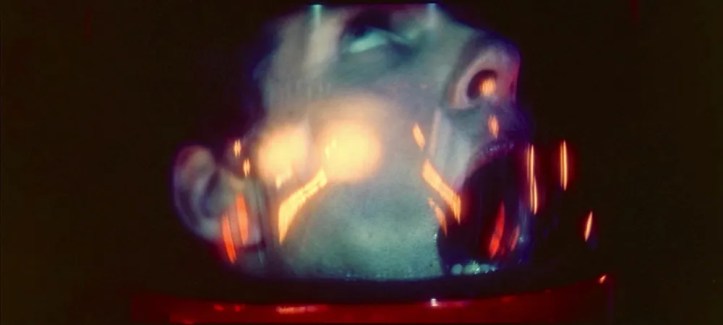
It’s not subtle.
Stanley Kubrick was a visionary. He tried to warn us. But we didn’t see.
Maybe because we didn’t want to see.
Even tho it was staring us right in the face all along.
So. Yesterday I went to The Prince Charles Cinema in London to watch 2001: A Space Odyssey on their big screen 1. I’ve already seen 2001: A Space Odyssey more times than I know. I run something called The All Out of Bubblegum Film Club where a bunch of us watch different movies and then we all meet up afterwards to discuss them for 3 hours. We did 2001 last year and talked about it for 3 hours and I kinda thought that maybe that was the end of it and I didn’t need to think about 2001 anymore. That I’d managed to pick the whole movie clean and there was nothing more to uncover.
But I was wrong.
Stanley Kubrick was a visionary. He tried to warn us. But we didn’t listen.
It’s not our fault. The warning was too beautiful. Too magnificent. We were captured and drawn in by the very thing that we should have run away from.
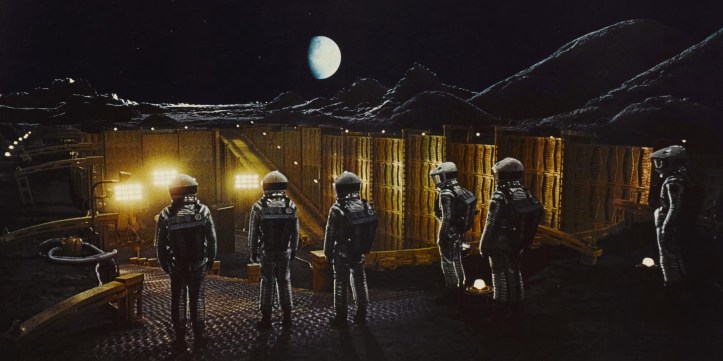
But now it’s too late and there’s no escape.
I’m part of the problem right now and if you’re reading this then so are you. I’m sorry. But there was nothing I could do.
Like I said it’s already too late.
Some people think that films change. But that’s not true. 2001: A Space Odyssey is exactly the same film it is now as it was when it was first released in 1968. But the world outside it has changed. We’re now 24 years past the future that it predicted and there’s things now in the film that people couldn’t see before. The world has changed and the film has opened up new dimensions inside it.
Let me explain.
There’s a moment about halfway through 2001 when Dave Bowman and Frank Poole are chilling out, eating food and watching BBC 12.
The BBC 12 bit is the only part that he didn’t get right.
Don’t stop me if this looks familar.
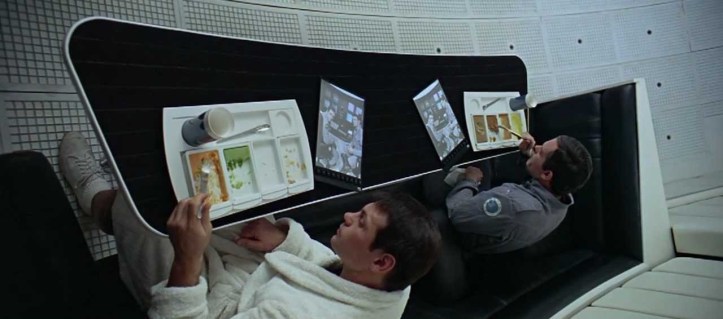
Watching this scene it in 2025 is a strange experience. Here’s people in 1968 imagining what life would be like 33 years into their future who instead managed to imagine ours. People sitting around watching screens.
What makes it even worse is that they’re not even watching themselves. Which could maybe be excusable. If a little obsessed. But no. Instead they’re watching HAL. Their ship’s computer. An artificial intelligence.
Of course this means something much different now in 2025 than what it did in 1968.
There was something about this scene that made me feel very sad. Me sitting down watching them, watching them watching HAL. It felt like a waste. Is this what humanity has been reduced to? Sitting down passively watching images on a screen. Completely disconnected from the real world around them?
I reached down and scooped up another handful of popcorn.
There’s a guy on the internet called Rob Ager who runs a YouTube channel called Collative Learning. It’s good. I’d recommend it. Lots of his videos are really interesting and give you new ways to see films that you’ve already seen before.
He has a very good video called 2001 A SPACE ODYSSEY monolith as cinema screen. We’re the apes. Film analysis Rob Ager. 2025
His cool insight is this: in order to understand what 2001 is all about – you have to change your point of view.
The clues are all over the place. All you need to do is watch it the right way. Open your eyes. See the things that are right in front of you.
There are so many instances scattered around the film of people and objects changing their positions. Walking on walls. Flipping themselves around. Altering their orientation.
The horizontal becoming the vertical and the vertical becoming horizontal.
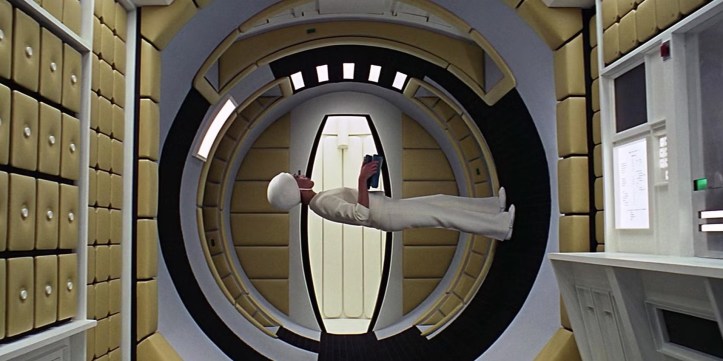
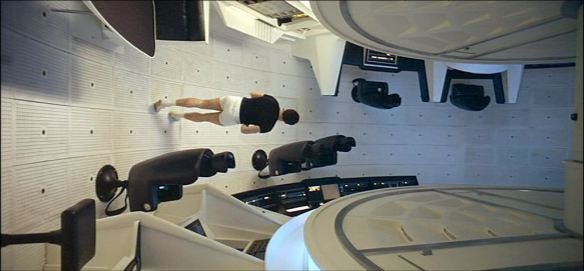
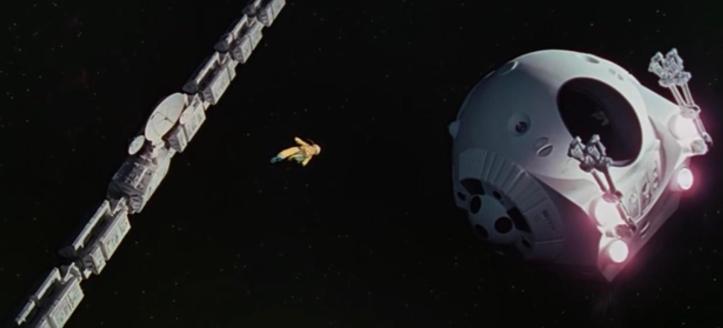
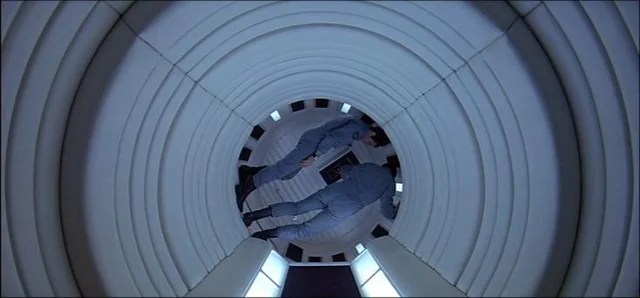
It’s not subtle.
Even the Stargate does it.
First it’s vertical.
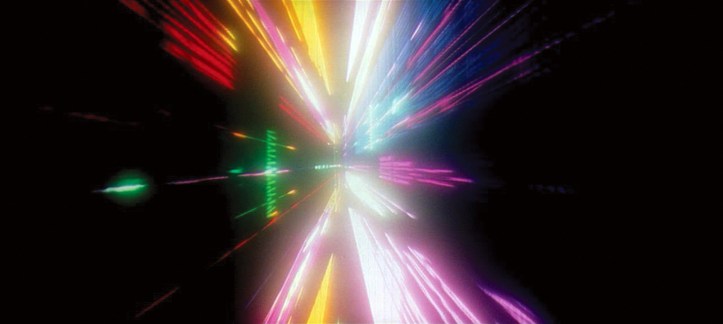
And then it flips.
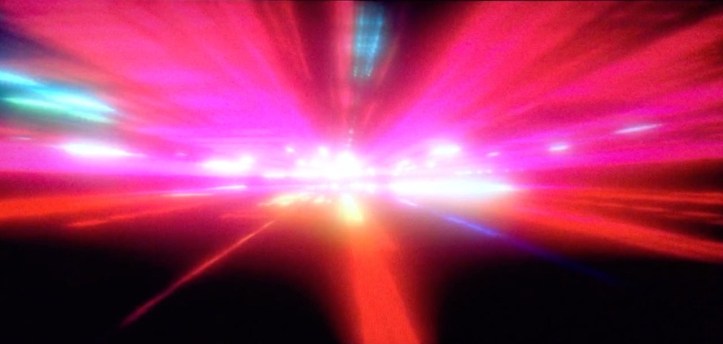
All you have to do is tilt your head and the answer is right there in front of you.
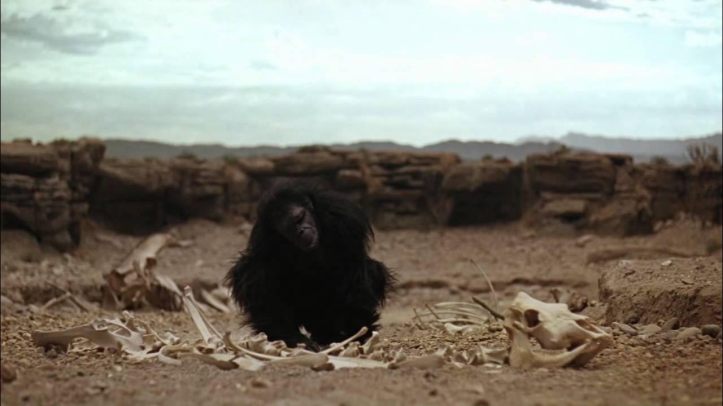
Turn the Monolith around 180 degrees you will see it for what it really is.
You’ll see it for what it’s always been.

Yes. That’s right. The monolith is a cinema screen.
Yes. Stanley Kubrick was a visionary. I know.
If you keep this idea in mind as you watch the film then whole new avenues of meaning start to open up. Like pathways in your mind. Like little stargates.
Take the scene when the monolith first appears.
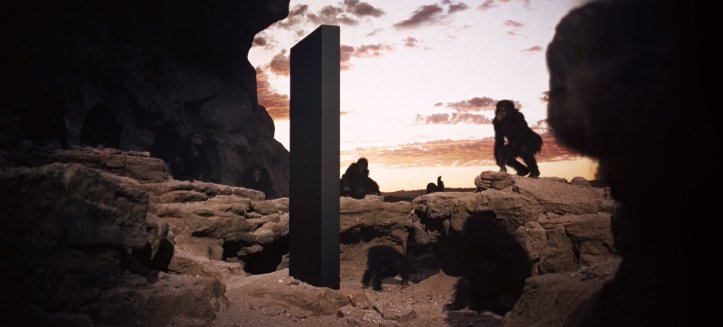
Most people think of 2001: A Space Odyssey as being a film about alien intelligence. And so they see this scene as the first appearance of some sort of divine extraterrestrial life-form that has come down to Earth in order to kick start our evolutionary process and advance us to the point where we can ascend off our planet and become Star Children or whatever. So we can all hold hands and float around in the cosmos bringing peace and harmony to all.
Apparently there was supposed to be a final sequence of 2001 where the Star Child went around blowing up all the space nuclear weapons platforms and bringing peace to the planet but according to reports Kubrick thought it was too close to Dr Strangelove.
This was the correct decision.
Stanley Kubrick was a visionary.
But if you watch the same scene with the monkeys and interpret the monolith as a cinema screen then it takes on a different meaning.
Now the stupid monkeys aren’t responding to aliens – they’re responding to pure concentrated cinema. They’re like the French people seeing Train Pulling into a Station for the very first time and they’re losing their goddamn minds. They’re going wild. They’re freaking out. They saying “what the fuck is this?” in their French accents / monkey voices and they’re reaching out to touch it to see if it’s real or not.
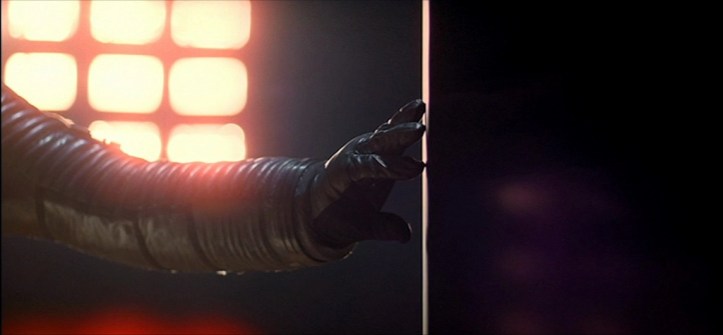
Touch is pretty important.
You can’t know if something’s real just by looking at it after all.
Of course once the monkeys have imbued the power of cinema they’re able to up their games and level up. They’re inspired to pick up bones and start bashing things. Which yes is toxic masculinity at it’s worst but does seem to pay off for them in all sorts of handy ways.
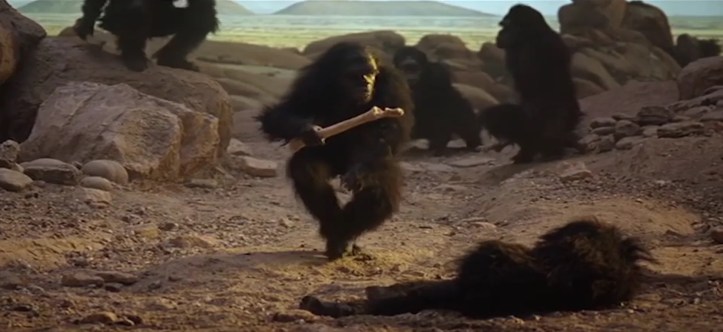
A monkey’s gotta do what a monkey’s gotta do etc.
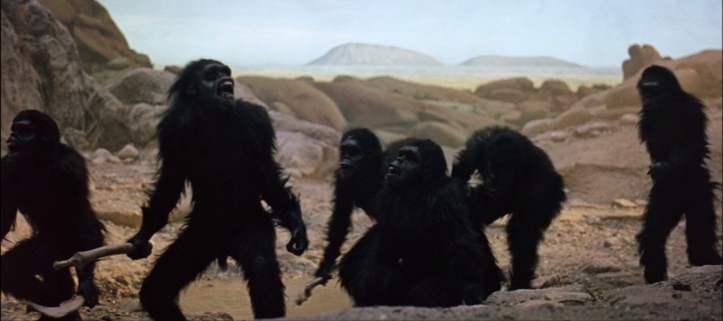
Victory is sweet.
This seems to be a good example of the good side of the monolith. You see stuff on a screen and it teaches you how to do things in the real world. You go out there and you become more effective. You make innovations. You rise up and succeed. All to the good. And in several generations time your ancestors are out there building spaceships and making bases on The Moon. Congratulations. All hail the power of imagination. All hail the power of cinema.
But what happens after that?
Well. After that. The screens start to propagate.
A good example. What’s the first thing that happens after a bunch of humans discover what could be the most important finding in the history of Science?
What does the film show us?
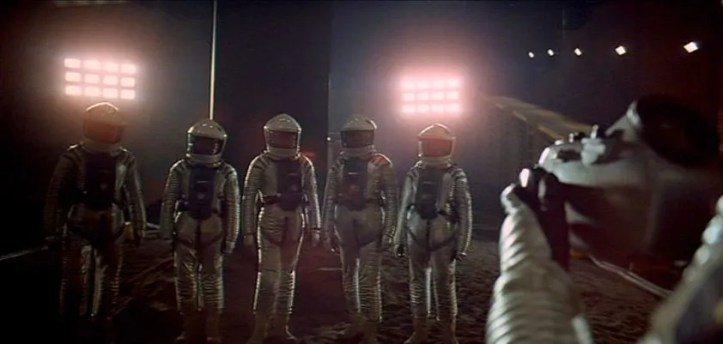
Of course of course.
Lots of people have pointed out that one of the interesting features of modern movies is that none of them really tend to feature mobile phones or people looking at screens. Instead they tend to be set in the past or they create scenarios where people don’t have access to their devices. The general consensus is that there’s nothing more boring than watching people looking at their screens.
2001 doesn’t really have this problem. In fact if you were to try and sum up the whole movie I think you could do a lot worse than to describe it as a film full of people looking at screens.
Are you watching?
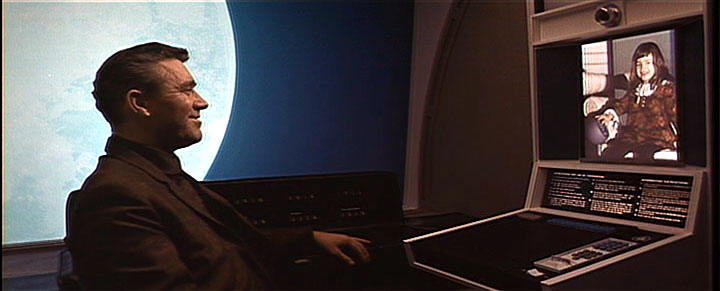
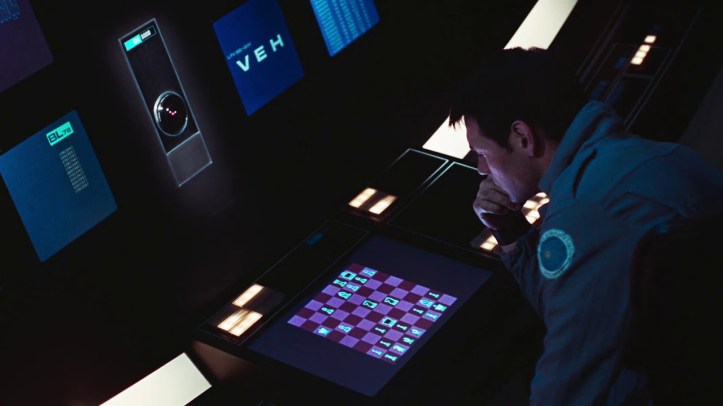
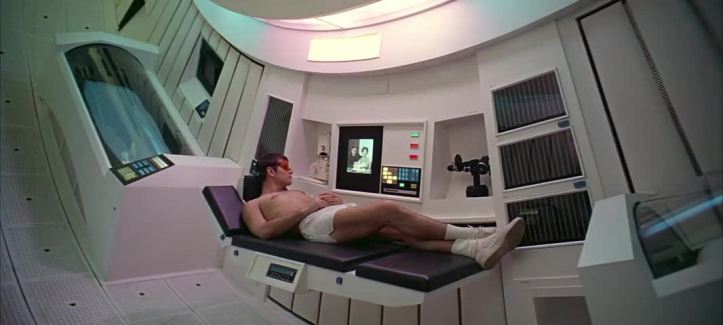
Eat some more popcorn.
Of course no one minds this. They don’t think it’s bad. They’re perfectly happy and content. They’re connected to their loved ones. They’re playing games. They’re celebrating their birthdays. Everything is great.
Of course the problem they don’t realise until it’s too late is that their screens are now so advanced that they’re now watching them.
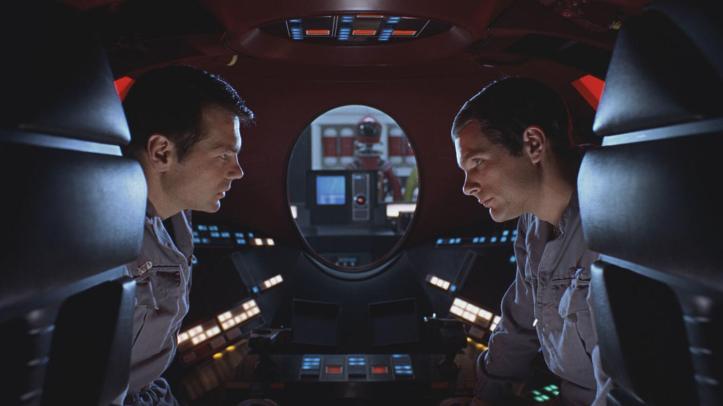
Whoops.
Too much monolith. Too much screen.
Of course the movie shows us that HAL is only a little screen. He’s cute. Diminutive.
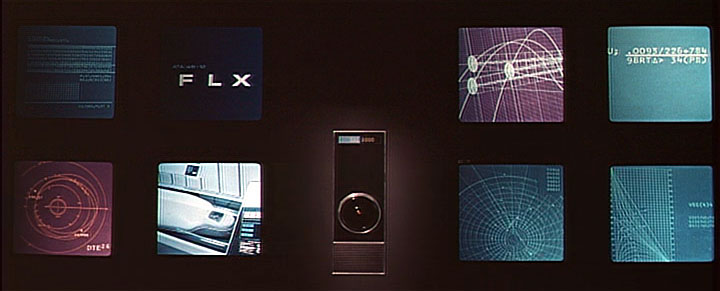
If you’ve been paying attention and watching properly then you’ll know that the big worry here is that Dave Bowman will struggle to defeat such a deadly foe. From everything we’ve seen of him in the film so far he’s weak and passive. More used to watching things than doing them. Hardly the type of guy who knows how to get things done. Not the type of guy to go on the attack like the monkeys at the start. No. He’s way more chilled and civilised. But he’s too chill. Too civilised. When HAL refuses to open the pod bay doors he doesn’t even swear. He’s calm and magnanimous.
How on earth will such a creature be able to fight back?
Luckily the film doesn’t ask him for too much. His one big single moment of action requires him to do nothing more than fall.
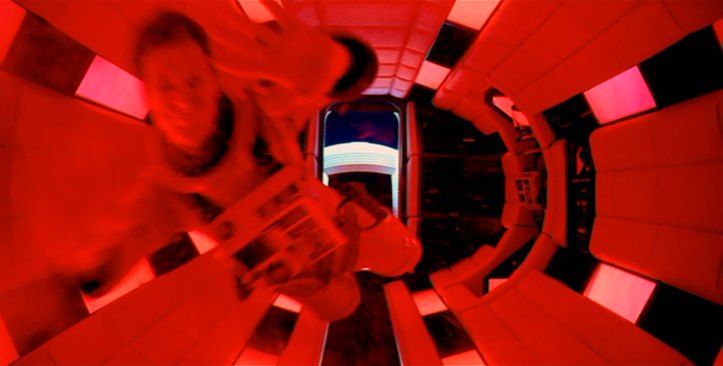
It seems brave yeah. But this is doing nothing more than what a stone can do. Dropping from one place to the next. The ultimate passive hero.
And then after that?
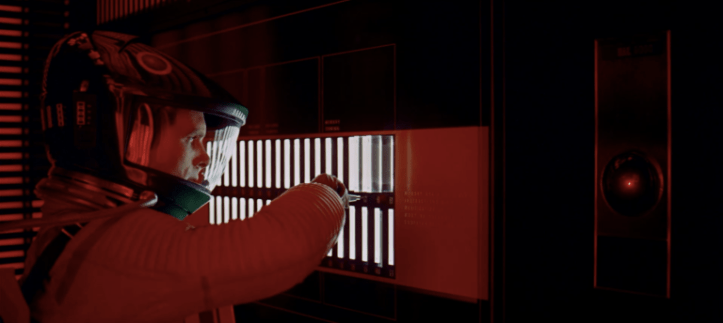
His big triumphant action is to turn some screws around. That’s it.
Yes yes. Daisy Daisy. It’s all very sad and harrowing I agree. But in terms of what Dave is actually doing. It’s basically the same as watching someone fiddle with the settings on the back of a TV.
“Can you see the picture yet?”
Stanley Kubrick was a visionary.
And so after his defeat of the little screen Dave Bowman goes up against the final boss.
The big mother monolith itself.
And loses.
Completely and utterly.
This is the moment that Kubrick goes gloves off. Everything before this was merely a preamble. Up until this point all the screens we were facing were small and contained. They had their uses and their dangers but they could all be overcome.
But the final monolith is like HD 4K.
It’s the ultimate overwhelming visual experience.
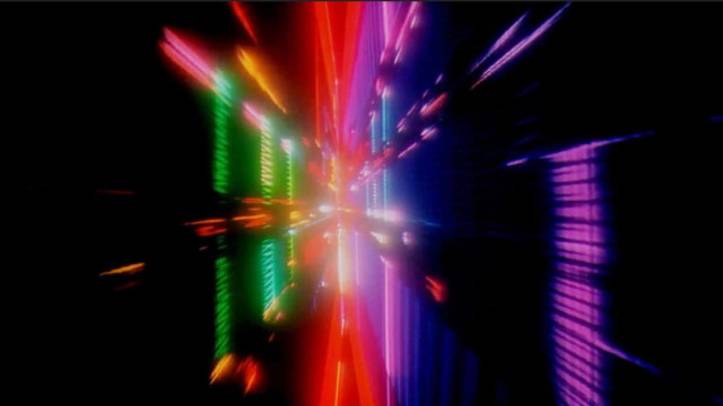
It’s like nothing Dave Bowman has ever experienced before.
The monolith turned up all the way.
Pure light and pure sound.
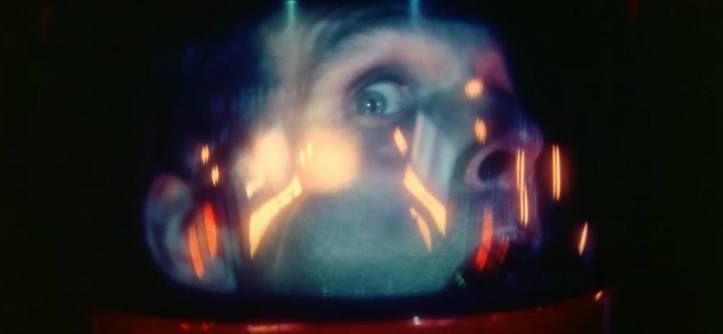
And so Kubrick gives us the most visually overloaded sequence in the history of cinema. Everything completely divorced from any sort of human context. Just different colours and shapes that defy any attempt we might make to make sense of them.
Completely cut off from anything real or physical. Or like they say in Orange County Prison – “No touching!”
Pure and ultimate cinema.
A feast for the eyes and the eyes alone.
And just to underline this point and to make sure we don’t miss it – Kubrick shows us this.
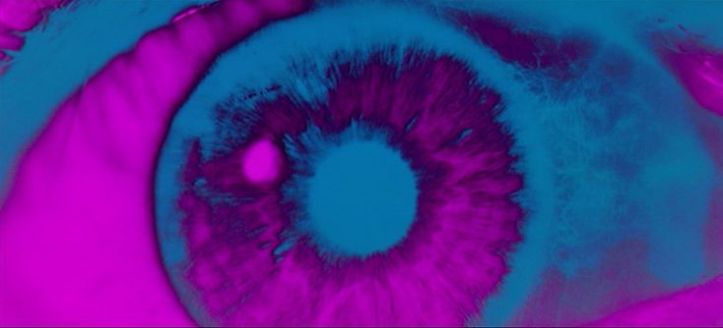
And this
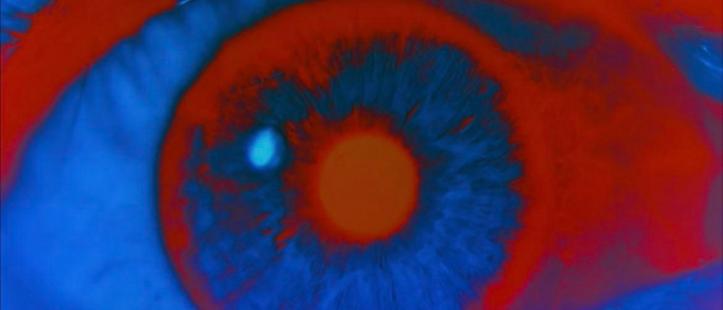
And this
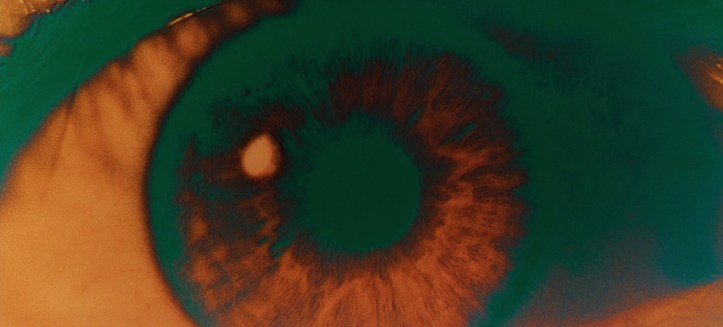
It’s not subtle.
What’s inside The Monolith is purely visual. There’s nothing inside it that’s real. All it is – is a feast for the eyes. Nothing else.
It’s just a screen.
It’s just cinema.
And then what do we find at the end of that?
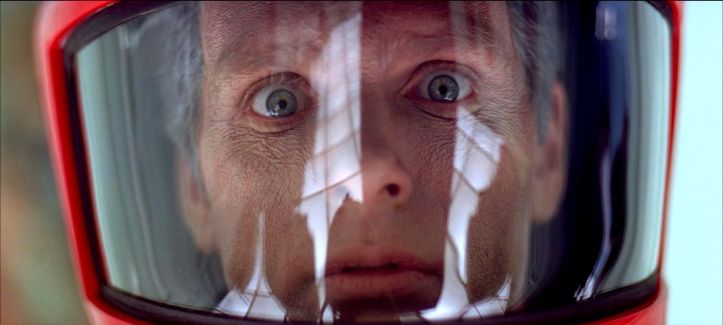
Some people think that the end of 2001 is about Dave Bowman making contact with alien beings. That he is taken through a Stargate and put inside an alien zoo that recreates a location out of his memories where he can be comfortable and happy while he lives out his life before he is advanced to the level where he becomes a Starchild and can take his rightful place amongst the cosmos.
Well. That’s not what I see.
What I see is something much more tragic and horrific.
What I see is the end result of someone who’s been plugged into their screens too much. What I see is someone who has become a voyeur even of their own life.
There are no aliens at the end of 2001. There’s just a man looking at himself. As he slowly gets older.
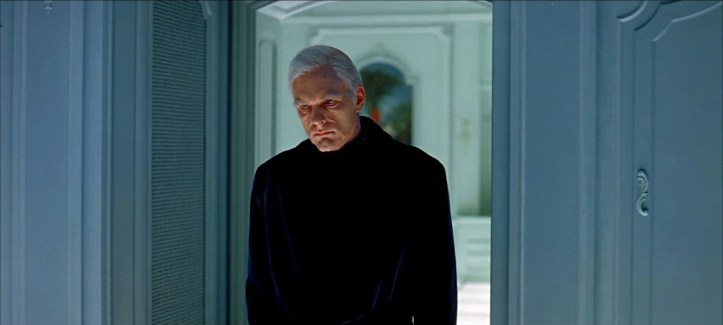
Is this not the ultimate depiction of a love of screens? Of spending your whole life looking at other things? Dave Bowman spends the rest of his life cut off from all human contact in a clear white room where he’s the only thing that exists. Denied even the possibility of going outside and touching grass because there is no way out. There is only himself.
Until all that’s left is his body slowly decaying around him.
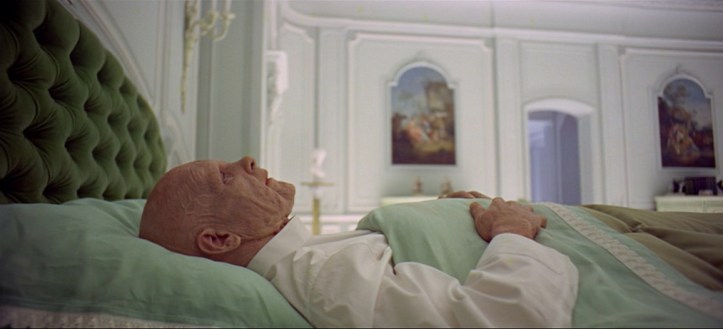
The ultimate cinephile.
Trying to touch a screen that is constantly out of reach.
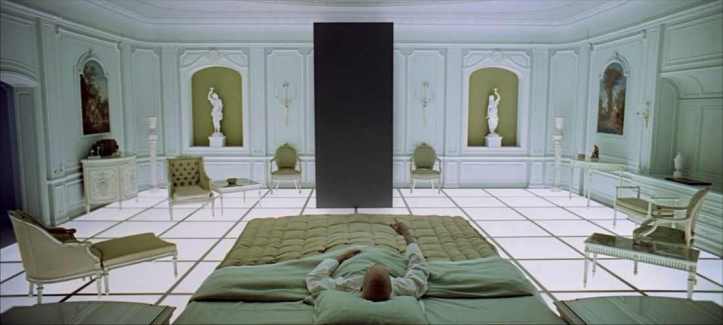
Cut to black.
Although wait. That’s not quite it. There’s more.
The film isn’t as bleak as I’m making it out to be. At the end Dave Bowman is transformed into The Star Child and it’s all glorious and happy right?
I mean – look at him.
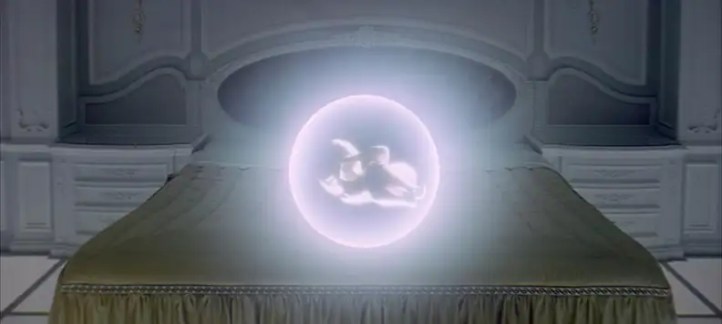
Isn’t this a hopeful image? Isn’t this a promise of a better future?
Again. I say no.
This is horrible and horrific. This is the end of human beings.
It’s like the humans in their little pods in WALL·E. Although at least with WALL·E there was still the possibility of escape. Of exiting the pod and reestablishing their humanity.
But with the Starchild there’s no such option. Dave Bowman’s entire being has been reshaped and there’s no way out. He’s been reduced to a helpless infant and cocooned within a ball of light.
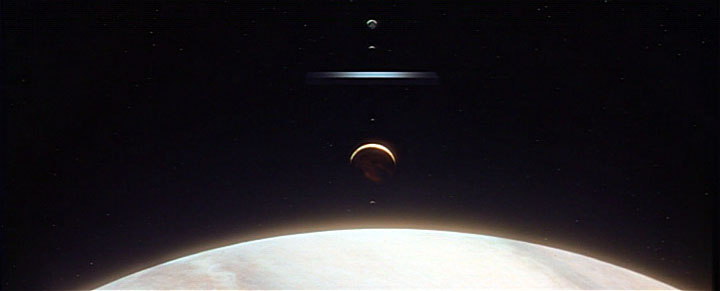
And then he’s released into the cold empty blackness of space. Above the earth.
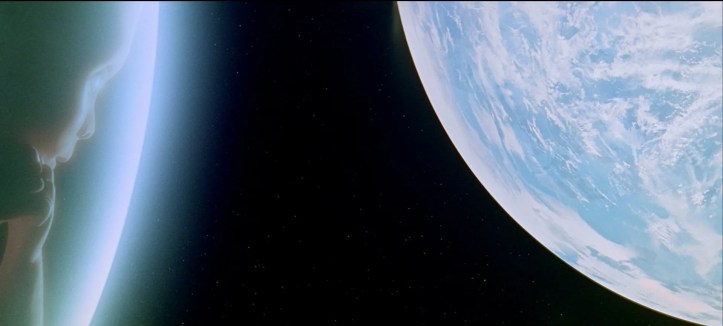
Hanging above the planet with no way to interact with any of his fellow humans. No way to touch them. Completely enclosed with his own little world. Completely inert. Completely passive.
With no way to break free.
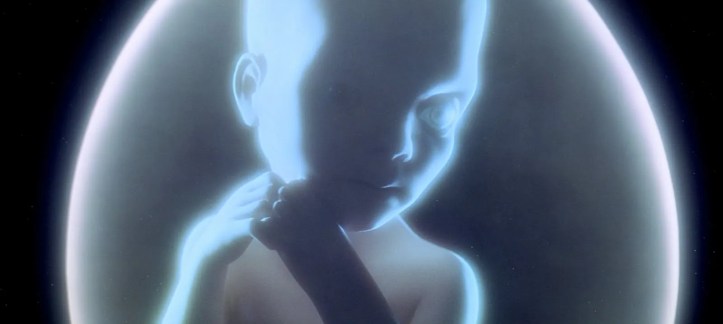
All he can do is watch.
2001: A Space Odyssey is a warning about the danger of cinema.
Or more specifically – a warning about spending too much time in front of a screen.
Stanley Kubrick was a visionary. He tried to warn us. But we didn’t see.

